


From Mosley to Farage? Victimhood, Legitimacy, and the British Far Right

Nigel Farage, leader of Reform UK, recently resigned as an MP, vowing to take on the “establishment,” which he claims seeks to thwart his political progress and, by extension, the people’s voice. His appeal to voters to defeat this alleged campaign by re-electing him echoes grievance politics historically employed by the British far right, which has portrayed itself as a defender of the people and free speech while interpreting political setbacks through a sense of victimhood.
Farage has cultivated an image of himself as a victim of establishment persecution, despite facing scrutiny over earlier admitted breaches of parliamentary rules and fresh allegations of unregistered financial support. His resignation has triggered a by-election in which he intends to seek a renewed mandate. However, the political satirist Count Binface’s entry into the contest as a protest vote, and the media circus it has attracted, obscures a deeper historical parallel between Farage’s rhetoric and the far right’s long tradition of grievance and victimhood.
Whilst Farage rails against the “establishment,” his term for the Labour and Conservative duopoly, he echoes Sir Oswald Mosley’s attack on “the old gang.” Mosley, leader of the British Union of Fascists (BUF), is remembered for marching his jackbooted, fascist-saluting ideologues through Britain’s streets in the 1930s. Yet his rhetorical strategies bear striking similarities to the less theatrical grievances expressed by Farage. Historians have debated whether to label Farage and Reform a contemporary manifestation of the British far right. Regardless of these important distinctions, Reform’s call for migrant deportations, repeal of the Human Rights Act, along with Farage’s “if in doubt kick them out” refrain, and his paid Cameo message promoting a Canadian neo-Nazi event all point to a demonstrable rightward shift in British politics. It is nevertheless significant that Farage and Reform have also endeavoured to avoid the pitfalls of Mosley’s “far right” label, revealing the shifting historical boundaries of political legitimacy in post-war Britain.

Following the Second World War, fascism was politically and culturally discredited, deemed beyond the pale of the British liberal tradition and anathema to Britain’s national story. This was reinforced by the memory of fascism as a wartime enemy, producing a political climate hostile to overt fascism. Since then, association with the far right in Britain has proved electoral suicide, despite limited successes in local and European elections. Nevertheless, if Reform’s May 2026 local election results mirror wider trends, they suggest that a large share of the electorate is receptive to a policy offer centred on immigration issues, mediated by emotive appeals to victimhood, grievance, and anti-establishment resentment. This ought to prompt the question of why rhetoric that once supported Mosley’s movement might re-emerge in a new political context.
Exhausted by the aftermath of the First World War, Britain was further shaken by the Great Depression, which intensified proto-fascist politics and created the conditions from which Mosley hoped to build his movement, drawing inspiration from Mussolini’s demagogic oratorical flair for fascist street politics. Mosley cast himself as a British strongman capable of breaking through Parliamentary torpor amid an unrelenting series of crises; as Julie Gottlieb observes, this historical background still feels relevant in our own time of permacrisis.
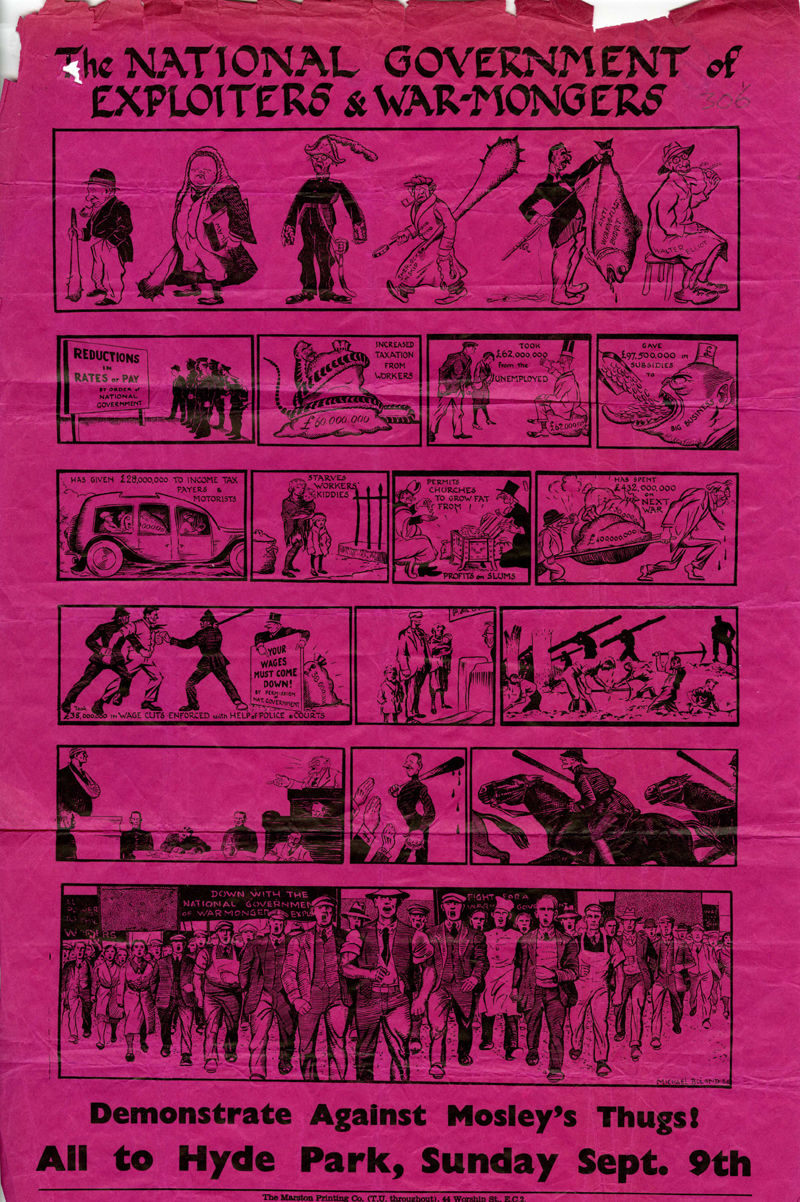
Despite early backing from The Daily Mail and Mosley’s notoriety as a former Conservative MP turned Labour member, public support for the BUF waned as street violence escalated, notably at the 1934 Olympia rally and the Battle of Cable Street in 1936. Subsequently, the Mail quietly withdrew its support, and the government banned all political uniforms in public – a move widely understood at the time as explicitly targeting the BUF. Following the outbreak of the Second World War, the BUF was proscribed, and Mosley and many of his supporters were detained without trial under Defence Regulation 18B as possible Nazi quislings, ending the BUF's political ambitions.
Mosleyites internalised this interwar political failure through what I term a “culture of victimhood.” My research argues that this culture provided an emotional, rhetorical, and interpretive framework through which Mosleyites explained political failure as the result of betrayal, censorship, persecution, conspiracy, or deliberate misrepresentation by opponents. This emotional response later served as a stimulus for the memory activism of Mosleyite ideologues during the 1980s and 1990s, who conducted their own oral histories with BUF members. These recordings reveal how this culture arose from the interaction of these factors, which were retrospectively narrated as the overlapping causes of their defeat.
However, this culture should not be regarded as mere evidence of selective or faulty memory, a common critique levelled at oral histories, particularly those involving political extremists. Mosleyite literature from both the pre- and post-war periods shows that Mosley's ideologues increasingly came to see themselves not as authors of political violence and extremism, but as victims of betrayal, censorship, and persecution. Indeed, during detention and after their release, Mosleyites wore hand-stitched badges and tie pins bearing the slogan “18B: victims today, victors tomorrow,” echoing Mosley’s earlier injunction to “guard that sacred flame” of fascism against future obstacles.
Supporters interpreted and articulated the Mail’s abandonment as a betrayal, the Olympia violence as self-defence against communists and Jews, and rejected the memory of Cable Street as an unfair demonisation of their movement. Most significant, however, was that their interpretation recast internment under 18B as the repression of political prisoners, rather than as a state measure justified as necessary for wartime security. These experiences generated internal accounts that supported post-war efforts to portray fascism as misunderstood and unjustly suppressed, rather than as discredited political extremism.
In 1948, Mosley attempted a political comeback, forming the Union Movement from the BUF's remnants. He aimed to exploit post-war xenophobia and anti-immigrant sentiment directed against Caribbean migrant workers. The attempt failed; Mosley lost his deposit in both the 1959 and 1966 elections. These defeats formed a broader post-war pattern in which overtly far-right organisations—from neo-Nazi groups seeking to supplant Mosley’s influence to the BNP of the 1990s and 2000s—struggled to secure national political legitimacy, even when they softened or concealed their fascist inheritance.
In this context, openly fascist organisations have routinely struggled to achieve electoral viability. Even throughout Brexit-era anti-immigration campaigning, overtly far-right parties have failed to enter Parliament. As Nigel Copsey notes, the far right remains engaged in a “quest for legitimacy” through electoral success. This quest has helped reshape their rhetoric. Elements of fascism did not disappear, but victimhood narratives and grievance politics, like those articulated by Mosleyites, are increasingly inflected by Reform. Reform’s claim that the far right is censored and that their rights to free speech are denied by the liberal elite, thereby stifling the will of a “silent majority” and facilitating national decline, is prominent. As Mosley’s political star waned throughout the 1960s, many of his followers drifted towards rival organisations, taking the culture of victimhood with them.
Yet despite Britons’ routine rejection of overtly “far-right” extremism, substantial parts of the electorate have embraced Farage, whose rhetoric on immigration and the decline of “Englishness” draws on themes of civic and national decline familiar in far-right politics. Though Reform seeks to remain within the bounds of political acceptability and therefore electorally viable, racist social-media posts by some Reform candidates further expose the porous boundary between a more restrained right-wing populism and the extremism of far-right groups such as the BNP, National Front, or Britain First.
The populist right has built a common interpretive framework that emphasises victimhood, censorship, and the belief that hostile elites undermine political expression. Mainstream electoral competition from the right now freely employs rhetorical forms once confined to the fringe. My research traces this repertoire across Mosleyite memoirs, oral histories, and archives. While these sources do not provide a direct link between Mosley and Farage, they show how defeated fascists turned victimhood, censorship, and betrayal into a durable explanation of political failure, and how comparable rhetorical forms now operate within right-wing populism. In this way, criticism becomes establishment persecution, exclusion becomes proof of authenticity, and hard-line policies are presented as the defence of a silenced people. Farage’s success therefore suggests not the return of fascism unchanged, but the normalisation of rhetorical forms formerly associated with the far right, after they have been detached from overt fascist identity and repackaged as democratic populism.

Kevin Harris is a PhD candidate at the University of Sheffield, funded by the White Rose College for the Arts and Humanities. His thesis is titled “Contested Memory: The Preservation and Politics of Archiving the Far-Right.” He graduated with an MA in Modern History from the University of Sheffield in 2024, receiving the Dorothy Philips Research Award and the Crewe MA Dissertation Prize in History. He has served as a Research Assistant and Project Officer on Baldwin and Gottlieb's "The Nervous State.”
The views and opinions expressed in this post are solely those of the original author/s and do not necessarily represent the views of the North American Conference on British Studies. The NACBS welcomes civil and productive discussion in the comments below. Our blog represents a collegial and conversational forum, and the tone for all comments should align with this environment. Insulting or mean comments will not be tolerated and NACBS reserves the right to delete these remarks and revoke the commenter’s site membership.


Comments