


How Queer Became Posh: Class and Representations of Non-Normative Sexuality and Gender

Updated: 4 days ago
Right-wing populist opponents of LGBTQ + rights in the 21st century have frequently depicted them as elite concerns, irrelevant to “ordinary working-class people.” Examples can be found from around the globe, from J.K. Rowling, to the Vatican, to the Modi administration. Queer people, especially lesbians and trans people, are disproportionately likely to experience poverty. Yet the “rich gay myth” persists, with a new iteration which critiques trans rights as the preoccupation of a pampered wokerati.
The rich historiography on queer and trans people in the 19th and early 20th centuries has, inadvertently, tended to support rather than disrupt this classed representation of non-normative sexuality and gender. With a few brilliant exceptions, most histories of LGBTQ + people have focused on middle or upper-class subjects. This is especially the case for histories of lesbians and/or trans men. I suggest that the paucity of research on working class-proletarians reflects the degree to which homosexuality was fundamentally classed from the moment it emerged in Britain as a clearly delineated concept. In other words, “queer” has always been understood as “posh.”
The reasons why there is far less research on working-class queers than on their wealthier counterparts are partly methodological (a lack of historical sources) but also due to intellectual and political shifts within the discipline of history. Queer history was very much part of the poststructuralist turn, which represented a profound challenge to the materialist underpinnings of most scholarship on class, and class as a concept became much less frequently deployed in the 1990s at the moment when the history of sexuality began to gain a foothold in the University. As their institutional fortunes diverged, they came to be viewed as distinct and sometimes even antagonistic. As Matt Brim observes, “[c]lass is barely indexed in most Queer Studies scholarship,” while in scholarship that continues to place class at its centre, “queer often does a disappearing act.”
Historians continue to debate the precise moment when modern notions of homosexuality emerged in Britain, whereby sexual-orientation came to be understood as an identity with its own distinct subcultures. The trial of Oscar Wilde, combined with the rise of sexology in the late 19th century, was certainly an important turning point, but historians have traced a concept of and hostility towards male homosexuality back to at least the late 18th century. Whereas it was once suggested that lesbians were able to pass under the radar in Victorian Britain (benefiting from invisibility under law), more recent historiography has argued that there was a public awareness of such relationships by the mid-1860s, and a “fully articulated” discussion of women’s same-sex desires and practices within the British medical establishment from 1870 onwards.
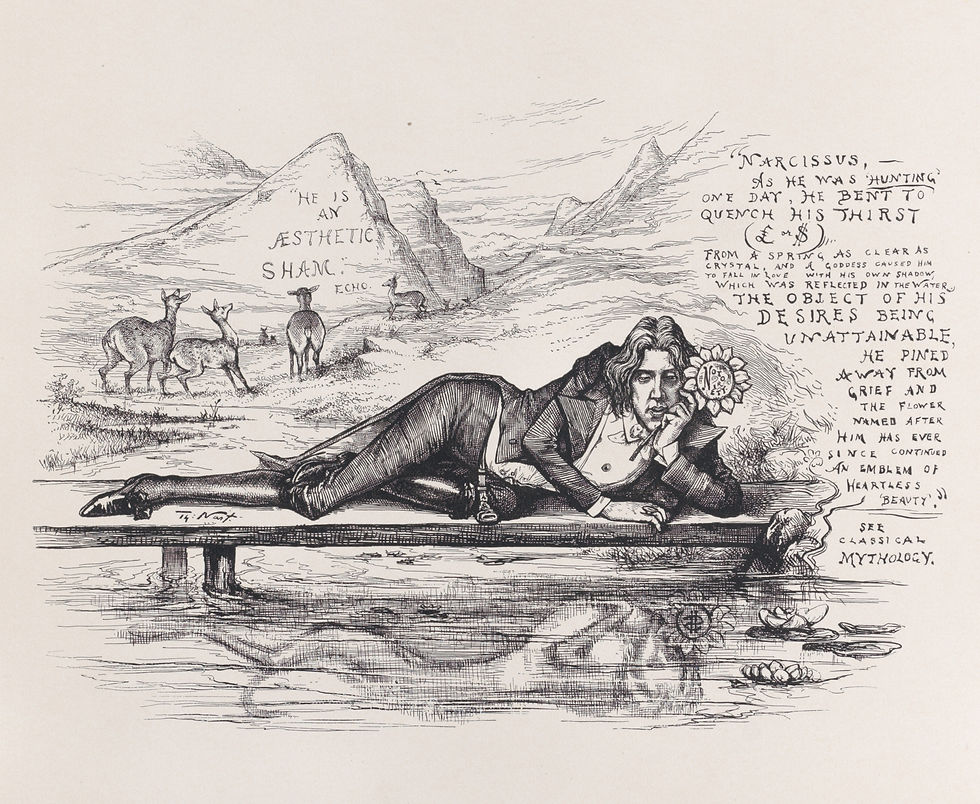
Although various modes of understanding same-sex desire existed and overlapped in the 19th century, one strikingly common trope depicted it as a “vice of the rich.” The most obvious example of this is Oscar Wilde who, in coming to embody the figure of “the homosexual” after his trial in 1895, entrenched homosexuality’s association with foppish upper-class decadence. I have found similarly classed representations of queer women in the 19th century. An 1868 newspaper article in the Glasgow Evening Citizen entitled “The ‘Mannish Woman of the Period’” identified her with typically upper-class activities such as marksmanship and the consumption of wine and champagne. Another, from the Fifeshire Journal that same year, complained about “grim females” guilty of an aversion to childbearing and other “unfeminine” traits, and claimed that such characteristics were to be found especially among “ladies” who were “so highly placed locally that they can afford to disregard public opinion.” There is a longer precedent, therefore, for what became the common association of lesbianism with upper-class degeneracy in the 1920s, which crystallised with the prosecution of Radclyffe Hall’s novel The Well of Loneliness, whose heroine is both a “sexual invert” and a member of the landed gentry.
Counter-tropes featuring working-class queers certainly existed. The most common of these was the virile and uninhibited manual worker fantasised about by wealthier homosexuals, whether in the idealised visions of cross-class relationships promoted by Edward Carpenter, or the more prosaic penchant for “rough trade” by the likes of Oscar Wilde. Victorian medical men, meanwhile, believed lesbianism to be particularly rife amongst prostitutes. Nonetheless, the idea of “queer as posh” has dominated to the degree that even in 2023 sociologist Yvette Taylor found that many of her interviewees felt themselves perceived as having somehow lost their working-classness through the fact of their queer or trans identity.
“Queer as posh” was not simply an idea promoted by elites. From the early 19th century, a current of working-class radicalism was also invested in associating homosexuality with the moral corruption of the upper classes. In contrast to the sexually “deviant” aristocracy, the working class were portrayed as innocent of homosexual vice. Thus the 20th century Stalinist notion of homosexuality as a capitalist disease had a much longer pedigree within the British labour movement.
As historians we need to be particularly conscious of how such assumptions might shape our own research agendas. I suggest that the history of working-class queer people has not simply been limited by a scarcity of sources but also, at times, intellectually and imaginatively foreclosed by the assumption that queerness is somehow antithetical to working-class culture. While it is important to recognise that material factors made it much harder for working-class people to act out non-normative sexuality and gender – the stakes of losing one’s job or the support of family networks being so much higher – we should not assume that it was a luxury that only the rich could afford.
At least a few working-class people deployed the new language to describe same-sex desire emerging from sexology and movements for homosexual rights at the turn of the 20th century. My own research has highlighted one member of the British Sexological Society: a domestic servant named Kathlyn Oliver who in 1915 described herself as a member of the “intermediate sex” – a term invented by Edward Carpenter. I recently cross-referenced correspondence to the British Sexological Society with newly digitised census data and found letters from a typist, a waiter’s daughter, a bootmaker, a lift operator, the mother of a “road man” and tailor, and 2 miners – all of which asked for more information on homosexuality with one describing in detail his sexual encounters with another man. Of course, we shouldn’t assume that working-class people operated in the same subjective registers as middle-class people, yet in an age of mass literacy and cheap newspapers it seems likely that at least some of them were aware of and laying claim to explicitly homosexual identities and subcultures.
There may be some merit in returning to those ruling-class fantasies of working-class queerness and reading them against or, rather, with the grain. Helen Smith’s work offers one example of how such an approach can be very fruitful. Rather than dismissing Edward Carpenter’s preoccupation with male industrial workers as an objectifying fetish (which of course it partly was), Smith asks what kind of culture might have produced the material for such fantasies, and thus transfers agency from an upper-middle-class reformer to working-class communities which, she discovered, inspired Carpenter’s vision of homosexual emancipation. In my current work on the “untraditional” working class, I deploy a “surface reading” of 19th and early 20th century sexological texts, which asks what happens if we take at face value elite male claims that lesbianism was particularly common among ballet dancers and sex workers.
In a context of rising “anti-gender” politics, which often draw on the long-standing trope of “queer as posh,” the need to write histories that disrupt it has become even more urgent.

Laura Schwartz is Professor of Modern British History at University of Warwick. Schwartz’s work has explored how feminism has influenced the emergence of secularism, the reform of higher education, and working-class politics. Schwartz is currently working on a book project entitled “Queer as Folk: Proletarian Countercultures in Britain, 1780-1939.”
The views and opinions expressed in this post are solely those of the original author/s and do not necessarily represent the views of the North American Conference on British Studies. The NACBS welcomes civil and productive discussion in the comments below. Our blog represents a collegial and conversational forum, and the tone for all comments should align with this environment. Insulting or mean comments will not be tolerated and NACBS reserves the right to delete these remarks and revoke the commenter’s site membership.


Comments