“Hello, Gay Switchboard?”: Tracing queer life through telephonic helplines in the 1970s and 1980s

When I first opened up a logbook of the Birmingham Gay Switchboard from 1977, I was overwhelmed by the everyday stories of queer life that have remained anonymous in our histories. In this small, scuffed, red notebook, its spine close to breaking, switchboard volunteers documented the stories of callers, from those who wanted to know more about local gay-friendly pubs, to discuss their sexuality, to enquire about local organizations, or simply those who wanted to talk to another like-minded person. In my trip to one of my local archives, located at Birmingham Library, I had encountered a way to stitch together the development of queer networks in Britain through the private, anonymous, and quiet stories of everyday switchboard activism.
Gay switchboards were telephonic helplines in Britain in the late twentieth century that helped queer people by offering information, advice, or conversation in order to support wellbeing of the queer communities they served. After the partial decriminalization of homosexuality in 1967 in England and Wales (later in Scotland in 1981 and in Northern Ireland in 1982), many gay and lesbian organizations worked to help queer people campaign for rights, including a visible queer culture. Yet, many queer people, or those questioning their gender and sexuality, could not live openly and were shaped by societal silences, discrimination, homophobia, or broader personal circumstances. Telephone helplines were popular with activist groups in the 1970s and 80s, as they offered a discreet and private way for queer people to directly connect with other like-minded individuals. Gay switchboards were embedded in broader telephonic culture and provided important networks for queer people to access information in a heteronormative society.
Because they developed in different localities across Britain, gay switchboards can help us to trace how queer life was shaped by local politics, economy, and geography, as much as national queer culture. Queer histories have tended to focus on metropolises like London or New York. As Jack Halberstam’s notion of “metronormativity” emphasized, there is often a tendency to think about queer life and cities together. Yet, recent work by historians in queer British history (Matt Cook, Alison Oram, Justin Bengry, Tom Hulme, and Rebecca Jennings, to name but a few) have showcased how queer life in Britain can be examined in different localities. Archival work on switchboards – which were a nation-wide phenomenon – can further illuminate the diversity of queer life and activism across Britain.
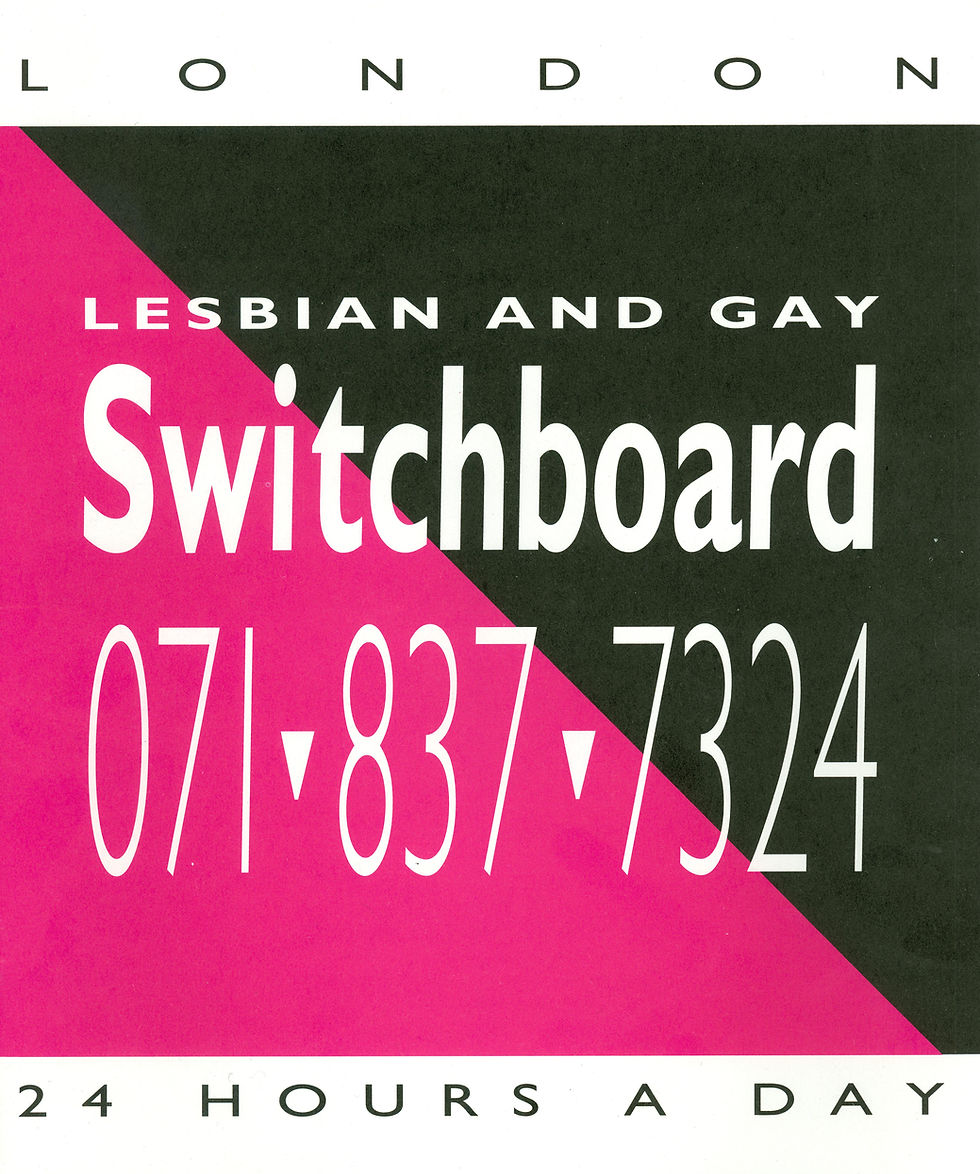
Though recent work has focused on the London Gay Switchboard – the largest and longest running organization, formed in 1974 above a bookshop in Kings Cross – different switchboards also formed in cities across Britain, some even predating London. In Scotland, Edinburgh Gay Switchboard (also known as Lothian Gay and Lesbian Switchboard) was founded in January 1974, formed from liaison between the Scottish Minorities Research Group and Samaritans (a charity and telephone helpline for anyone needing emotional support and for the prevention of suicide). Articles in Gay News, a leading gay magazine in Britain from 1972-1983, even suggest Oxford Gay Switchboard formed as early as 1972. Queer people, therefore, responded to the needs of a locality, and centered their queer activity or life in their own spaces. For example, in 1975 and 1976, gay switchboards were formed in Birmingham, Bristol, and Brighton. The near simultaneous establishment of multiple gay switchboards in different cities in the mid 1970s demonstrates the need for these resources across the nation. By the end of 1983, in its final issue, Gay News magazine listed 46 gay switchboards in Britain and the Republic of Ireland (Dublin and Cork).
Beyond their geographic spread, the sources these call lines left behind, like logbooks, offer a rich resource to understand everyday queer life. In order to assist callers, switchboards maintained informational files on local events, groups, and organizations. Cait McKinney’s research on the New York Lesbian Switchboard called this an act of “information activism,” describing the ways people collected and compiled information for reference during calls. In an era before access to information provided by the internet, gay switchboards relied on the work of volunteers to compile, collect, and organize information. Callers also played a role, informing switchboard volunteers about new venues or groups, hostility from pub or club owners, or queer life beyond their own city. Local callers also sought information beyond the town, city, or region they lived in, and, as a result, volunteers also compiled information from pages in gay and lesbian magazines or travel guides. The archives, and logbooks, are therefore rich sources to understand one aspect of queer activism across the nation, and how it evolved to adapt to the shifting needs of the queer community over time
Gay switchboards could not always meet the needs for all callers, and as a result, more specialized lines linked with sexual identity emerged in the late 1970s and 1980s. Gay switchboards were operated on a volunteer basis, staffed largely by gay men, with queer and trans women often in the minority of volunteers. Some lesbian volunteers wanted to dedicate more time to female callers, and many Lesbian Lines formed in the late 1970s and 1980s in order to prioritize lesbians. As Helen Bishop, a former volunteer at London Lesbian Line, recalled: “we needed a women-only service, both to provide information and to reassure women that it was OK to be a lesbian.”
Likewise, switchboards were imperfect organizations, and often reflected wider exclusionary politics in queer communities. For example, trans callers could be subjected to exclusion or denial because of heightened surveillance of vocal identity, or “women-only” policies at lesbian lines, which denied them information based on their sex assigned at birth. The 1980s, therefore, also saw the rise of additional helplines that addressed issues of diversity and exclusion in switchboard activism. For example, the TV/TS helpline in 1979 was the first trans helpline (formed from the TV/TS group from London Friend) and provided greater visibility for trans people to receive direct help and support. The Bi-sexual helpline in Edinburgh, was the first bisexual helpline in Britain, formed in 1987 to address biphobia and lack of bisexual visibility in queer communities. Queer helplines also often failed to address issues of racial and ethnic diversity, as a result, specific helplines like the Black Lesbian and Gay Switchboard in the late 1980s emphasized some of the failures of gay switchboards and lesbian lines.
Gay switchboards also adapted to the needs of queer communities in the long 1980s. During the AIDS crisis, switchboards helped to rally support to help those in need by providing information (by directing callers to AIDS information, crisis helplines, and organizations like the Terrence Higgins Trust or AIDS ACT UP) and providing a space for callers and those affected by HIV/AIDS to talk about their experiences. George Severs’ work on the HIV/AIDS crisis in England, indeed, emphasized how switchboards not only received calls from people concerned about HIV/AIDS, but people wanting to help out at switchboard to support the crisis with their own knowledge. In the 1990s, many queer helplines evolved into more professional and charity led organizations, in contrast to their earlier grassroots-style activism of in the 1970s.
Logbooks, therefore, help us understand this rich and complex history of gay switchboards in Britain and trace the everyday activism of switchboards, as much as everyday queer life. Switchboard logbooks are delicate artefacts that hold the personal stories of anonymous callers seeking help and advice. However, these stories are only materialized through the activism of the switchboard volunteers who documented the calls. Logbooks were typically simple notebooks, or sheets of paper organized in a large ring binder or folder. Logbooks are an interesting methodological source to understand some of the quieter and anonymous experiences of queer life. While switchboards did have reoccurring callers (which meant volunteers talked on a first name basis), the majority of caller were anonymous, and their names are not identified in records. And yet, these logbooks hold sensitive information and are often in closed collections in archives. For other switchboards, like Oxford Gay Switchboard, I have found it difficult to trace what happened to their logbooks – if they are lost, or were destroyed, or are simply sitting in a dusty box in someone’s attic. There is no sound archive of these calls, so descriptions and entries from switchboard volunteers provide the only glimpses of these mediated conversations.
In May 2026, LGBTQ+ activist and former volunteer and press officer at London Gay Switchboard, Lisa Power, discussed logbooks on the BBC show Repair Shop. During this programme, the switchboard’s first ever logbook – a fragile red notebook (seemingly a popular choice for switchboards) – was repaired. This logbook had no spine, and pages spilled out the side of the red cover. On the programme, a bookbinder carefully fixed a new spine on the logbook and sewed each individual page back to the new spine. This logbook, an important physical testament to queer life and activism, was restored for future generations and researchers. The content of logbooks reflects the dedication and joy of queer life and culture, while their materiality reflects the fragility and delicate nature of queer life at this time in the late twentieth century.
Gay switchboards in the 1970s and 1980s require further exploration, as these networks help us to understand how queer life, culture, and community developed across Britain. They provide a way to stitch together fragments of queer experience across different localities, and document the experiences of everyday queer life that remained anonymous, quiet, and private. What my future work hopes to explore is what queer telephonic activism can reveal about queer wellbeing in the 1980s across Britain. There is much more work to do, and many more logbooks to read.
Katherine Wallace is in the final stages of her PhD at the University of Birmingham, funded by the Wolfson Foundation. Her thesis focuses on lesbian social networks and activism in late twentieth century England. She also has a wider interest in queer and feminist histories, local studies, and archival work.
The views and opinions expressed in this post are solely those of the original author/s and do not necessarily represent the views of the North American Conference on British Studies. The NACBS welcomes civil and productive discussion in the comments below. Our blog represents a collegial and conversational forum, and the tone for all comments should align with this environment. Insulting or mean comments will not be tolerated and NACBS reserves the right to delete these remarks and revoke the commenter’s site membership.